
Best RV Solar Trickle Battery Charger for Storage (No More Dead Batteries)

Keeping your RV battery healthy during long-term storage isn’t just a good idea — it’s essential maintenance that can save you from expensive repairs or replacements down the road. A smart RV solar charger designed for trickle charging helps ensure that when you’re ready to roll out, your RV is too. No jump-starts, no dead jacks, and no surprises at the storage yard.
Proper trickle charging means your RV is ready when you show up for your next trip — and you don’t have to wonder if the tongue jack will work, or if the battery’s toast from sitting too long.
We learned this the hard way on our first Amerilite. We made the classic mistake of leaving the battery kill switch turned on during storage. Even though the dealer had walked us through that step, we skipped it on our checklist — and when we returned, the battery was completely zapped. Thankfully, we caught it early, removed the battery, and revived it with a plug-in trickle charger. After that close call, we installed our first solar trickle charger. Sometimes, you only need to make the mistake once.
When an RV sits unused for weeks or months, the battery begins to lose charge naturally. Add in parasitic drains like propane detectors, LED panels, or even your stereo’s memory — and that trickle of power loss adds up quickly. If the battery kill switch isn’t turned off, the problem compounds. The result? Deep discharge, sulfation, or permanent damage — especially in winter. That’s where a properly sized RV solar charger for trickle charging — usually a compact solar panel with a built-in controller — makes all the difference.
These compact solar battery chargers work completely off-grid — perfect for RVs stored outside or at a storage yard without shore power access. Once installed, they maintain your battery’s ideal float voltage safely, giving you peace of mind all season long.
In this post, we’re focusing specifically on solar chargers under 30W — the best options for RV battery maintenance during storage, not high-wattage panels for camping or off-grid living. Let’s look at what makes a great solar trickle charger, and the top options we’ve tested and scored.
For a deeper look at battery types, ideal voltages, and long-term care strategies, check out our full guide on RV battery systems.

Why You Need a Solar Trickle Charger for RV Battery Storage
RV batteries don’t like to sit idle — especially during long periods of storage. Even if you’re not using lights, appliances, or your water pump, your rig likely still has parasitic draws: think propane detectors, LED control panels, stereo memory, or even the circuit board in your fridge.
Pro Tip: Eliminate parasitic draw by turning off the battery! Use your battery kill switch. Make this part of your storage checklist!

🔋 Battery Saver – Maintains 12V batteries (AGM, GEL, flooded, lithium, LiFePO₄).
☀️ Fast Charging – High-efficiency monocrystalline panel.
⚡ Smart Controller – Auto-stop charging, reverse-drain protection.
💡 LED Status – Blue = sun, Red = charging, Green = full.
🌧 IP67 Waterproof – Built tough for all-weather use.
🚐 Easy Install – Lightweight with suction cups & carabiners.
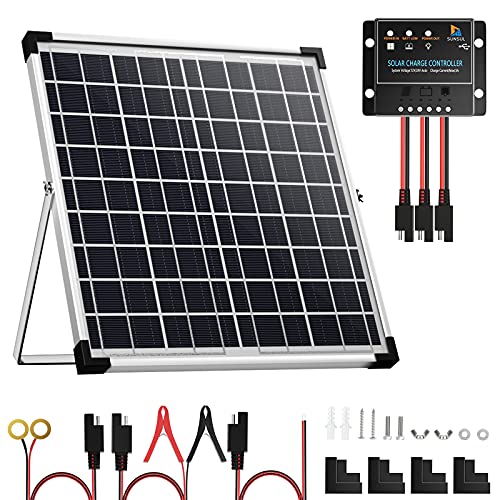
🔋 High Efficiency – 20W monocrystalline panel converts up to 23%.
🌧 Durable Build – Tempered glass, EVA film & aluminum frame; weatherproof for years of use.
🚐 Versatile Power – Maintains 12V batteries in RVs, boats, cars & more.
⚡ Smart Controller – 4-stage PWM with float mode, USB output & full safety protections.
🧲 Easy Install – Adjustable 180° bracket + pre-drilled holes for flexible mounting.
🛡 Reliable Support – 18-month warranty & lifetime technical assistance.

🔋 Smart Protection – Overcharge, over-voltage & reverse-current safe.
☀️ Efficient Panel – Textured surface boosts solar conversion.
💡 LED Status – Blue = sun, Red = charging, Green = full.
🌧 Durable Build – PET + epoxy backing, waterproof & dustproof.
🚐 Easy Install – SAE kit, suction cups & carabiners included.
These tiny loads quietly pull power, and over time they can lead to deep discharge — or worse, permanent damage. Add natural self-discharge into the mix, and your battery’s health can drop significantly over just a few weeks. If your battery kill switch is left on (been there, done that), the drain accelerates.
That’s where a solar trickle charger comes in. These low-wattage panels are specifically designed to maintain your battery — not recharge it from dead — by keeping it topped off at the proper float voltage (typically between 13.2V and 13.8V for 12V systems).
The key benefits:
- ✅ Prevents sulfation, which is the #1 killer of lead-acid batteries in storage
- ✅ Maintains battery lifespan without requiring shore power
- ✅ Peace of mind — your RV will be ready when you are
- ✅ Works anywhere, even at a storage lot or boondocking spot
A trickle charger with a smart controller delivers just enough power to counteract natural and parasitic drain, without risking overcharge. It’s a small investment that protects a much bigger one — your entire RV power system.

For more tips on preparing your rig for long-term storage, the Family Motor Coach Association has an excellent checklist covering everything from tire care to winterizing.
TL;DR: Best RV Solar Battery Chargers for Trickle Charging in Storage
- 🔋 Why it matters: RV batteries naturally lose charge in storage — especially with parasitic drains like propane sensors or control boards.
- ☀️ Solar trickle chargers use low-wattage solar panels (10–30W) with smart controllers to keep your battery topped off — no shore power needed.
- ✅ Look for chargers with:
- Float mode support
- Reverse-current protection
- Smart charge controller (PWM or MPPT)
- Compatibility with your battery type (AGM, flooded, lithium)
- Float mode support
- 🧲 Rare earth magnets work great for mounting panels on RVs in storage lots.
- 🏆 Our top pick: A 20W monocrystalline solar battery charger with a 4-stage PWM controller — the same one we personally use and trust.
- ⚠️ Skip solar trickle chargers if:
- You store your RV indoors or in deep shade
- You’re using lithium batteries without a compatible controller
- Your panel doesn’t include a charge controller
- You store your RV indoors or in deep shade
🎯 Bottom line: A smart RV solar battery charger is cheap insurance against a dead battery — and peace of mind all storage season long.
What Makes a Good RV Solar Trickle Charger?
Not all solar chargers are built for the same job. When you’re maintaining an RV battery in storage, you’re not looking for a high-output solar kit or a portable power station — you’re looking for a low-wattage, smart-maintenance solution that works quietly in the background to keep your battery healthy.
A good RV solar battery charger for storage should check a few critical boxes — especially if you want peace of mind all winter (or all summer) long.

✅ Key Features to Look For
Here’s what we prioritize when choosing a charger:
| Feature | Why It Matters |
| Smart Charge Controller | Regulates voltage and current; prevents overcharging or draining your battery. |
| Float Mode Support | Keeps the battery topped off without stressing it — ideal for long-term storage. |
| Reverse-Current Protection | Stops the solar panel from pulling power from your battery at night (a.k.a. reverse discharge). |
| Weatherproof (IP65+) | Withstands rain, snow, and dust when installed outdoors. |
| Mounting Options | Brackets, suction cups, or even rare earth magnets (our go-to method) help secure the panel to your RV in storage. |
| Battery Chemistry Support | Ensure compatibility with your battery type (AGM, flooded, gel, or lithium). |
⚙️ Why Smart Controllers Matter
A quality solar battery charger should always include a charge controller — and not just any controller, but one that supports smart, multi-stage charging. This is the brain of the system, and it ensures your battery receives just enough power to stay healthy.
Most smart controllers follow a 4-stage charging process:
- Bulk – Fast charging when the battery is low
- Boost (Absorption) – Brings the battery near full
- Float – Holds the charge steady to prevent overcharging
- Equalization – Occasional deep cycle for flooded batteries (if supported)
The float stage is especially important for RV battery storage. That’s the gentle trickle that keeps your battery right in the sweet spot — usually between 13.2V and 13.8V — so it doesn’t dip too low or get overworked.
⚠️ Avoid bare solar panels without controllers. These may seem like a good deal, but they lack regulation and can easily overcharge your battery during long sunny stretches.
⚠️ What Is Reverse Discharge?
If your panel doesn’t have a controller — or at least a blocking diode — it can actually work against you. At night or in heavy shade, the panel produces no voltage. If left unregulated, it can allow power to flow backward into the panel. This is called reverse discharge, and it’s like a slow leak out of your battery.
Even a few milliamps of reverse current can drain your battery over time — which defeats the entire purpose of using a solar maintainer.
✅ All the products we recommend include reverse-current protection via a smart controller, so you don’t have to worry about nighttime drain.
How We Scored These Trickle Chargers
There’s no shortage of solar battery chargers claiming to be “RV ready,” but not all of them are suited for safe, long-term battery maintenance during storage. Our goal was to separate the marketing hype from what actually matters when you’re trying to protect a $300 battery system during the off-season.
To do that, we developed a simple scoring system based on five core performance areas. Each category was weighted according to how important it is for RV storage use — not off-grid charging or camping.
🧪 Our Scoring Criteria
| Category | Weight | What We Looked At |
| Charging Performance | 40% | Panel wattage, solar conversion efficiency, and smart controller type (PWM or MPPT) |
| Durability | 20% | IP rating, frame materials (tempered glass, aluminum), and hardware longevity |
| Ease of Use | 15% | Setup process, mounting options, LED indicators, portability |
| Battery Compatibility | 15% | Support for flooded lead-acid, AGM, gel, and lithium (LiFePO₄) chemistries |
| Value | 10% | Price-to-feature ratio, warranty coverage, brand trustworthiness |
🔍 How We Evaluated the Products
We used a combination of real-world experience and in-depth research to rate each charger fairly:
- ✅ Hands-on use of our current 20W solar trickle charger
- ✅ Review of manufacturer specifications and technical documentation
- ✅ Analysis of verified buyer reviews, FAQ sections, and user photos
- ✅ Evaluation of warranty policies, brand history, and customer service responsiveness
This approach let us highlight chargers that consistently perform well in real RV storage environments — not just ones with inflated ratings.
🏆 Our Setup: The Charger We Personally Use
We currently use a 20W monocrystalline solar panel paired with a smart 4-stage PWM controller. It’s weatherproof, efficient, and simple to install — we’ve used rare earth magnets to attach it directly to the side of our fifth wheel during storage season.

Key Highlights:
- Converts up to 23% of solar energy
- Built-in 4-stage PWM controller (Bulk, Boost, Float, Equalization)
- Reverse-current protection and short circuit safety
- Adjustable angle bracket + pre-drilled frame
- Dual USB ports for extra charging flexibility
- Covered by an 18-month warranty with lifetime tech support
⭐️ Scoring Breakdown: Our 20W Panel
| Category | Score (1–10) | Notes |
| Charging Performance | 9.2 | Reliable 20W panel with stable float output and smart regulation |
| Durability | 9.5 | Aluminum frame, tempered glass, IP-rated build |
| Ease of Use | 9.0 | Quick install, versatile mounting, USB ports |
| Battery Compatibility | 8.5 | Lead-acid and AGM supported; lithium not specified |
| Value | 9.0 | Great performance for price; solid customer support |
✅ Overall Score: 9.0/10
This setup became our benchmark for comparing all other chargers in this guide. While we haven’t tested every product ourselves, we’ve prioritized real-world relevance over brand hype — and we’ll be clear about which units we trust most for long-term RV battery maintenance.

Best RV Solar Chargers for Trickle Charging During Storage (Under 30W)
Not every “solar battery charger” is built for battery maintenance — especially when it comes to long-term RV storage. Many products marketed as RV solar panels are actually overpowered for this use, designed to recharge rather than maintain. That’s why we limited this list to smart, low-wattage options under 30W — ideal for trickle charging and avoiding overcharge.
Every charger below includes:
- A smart controller with float mode support
- Reverse-current protection to prevent nighttime drain
- Enough wattage to offset parasitic loads, but not so much that it risks boiling your battery over time
🔋 Battery Saver – Maintains 12V batteries (AGM, GEL, flooded, lithium, LiFePO₄).
☀️ Fast Charging – High-efficiency monocrystalline panel.
⚡ Smart Controller – Auto-stop charging, reverse-drain protection.
💡 LED Status – Blue = sun, Red = charging, Green = full.
🌧 IP67 Waterproof – Built tough for all-weather use.
🚐 Easy Install – Lightweight with suction cups & carabiners.
🔋 High Efficiency – 20W monocrystalline panel converts up to 23%.
🌧 Durable Build – Tempered glass, EVA film & aluminum frame; weatherproof for years of use.
🚐 Versatile Power – Maintains 12V batteries in RVs, boats, cars & more.
⚡ Smart Controller – 4-stage PWM with float mode, USB output & full safety protections.
🧲 Easy Install – Adjustable 180° bracket + pre-drilled holes for flexible mounting.
🛡 Reliable Support – 18-month warranty & lifetime technical assistance.
🔋 Smart Protection – Overcharge, over-voltage & reverse-current safe.
☀️ Efficient Panel – Textured surface boosts solar conversion.
💡 LED Status – Blue = sun, Red = charging, Green = full.
🌧 Durable Build – PET + epoxy backing, waterproof & dustproof.
🚐 Easy Install – SAE kit, suction cups & carabiners included.
🏆 Top Pick – The One We Use: Sunsul 20W Monocrystalline Solar Charger Kit
Best Overall for RV Battery Maintenance
| Specs | |
| Wattage: | 20W |
| Controller: | 4-Stage PWM |
| Waterproofing: | IP65+ |
| Mounting: | Bracket + optional rare earth magnets |
| Batteries: | Lead-acid, AGM (not lithium confirmed) |
| Float Mode: | ✅ Yes |
| Reverse Protection: | ✅ Yes |
| Overall Score: | 9.0/10 |
This is the charger we personally use, and it’s become our benchmark for safe, reliable RV battery storage. With a high-efficiency monocrystalline panel, USB ports on the controller, and a rock-solid aluminum frame, this unit checks every box. We especially like that the bracket allows flexible tilt and placement — or, in our case, rare earth magnets make it easy to attach directly to our rig.
✅ Use case: Ideal for maintaining 12V lead-acid or AGM batteries in outdoor storage, especially with intermittent sun exposure.
🔧 SUNAPEX 20W Solar Trickle Charger Kit
Runner-Up: Best All-Around Value
| Specs | |
| Wattage: | 20W |
| Controller: | Built-in Smart PWM |
| Waterproofing: | IP65 |
| Mounting: | Suction cups or flat bracket |
| Batteries: | Lead-acid, AGM |
| Float Mode: | ✅ Yes |
| Reverse Protection: | ✅ Yes |
| Overall Score: | 8.2/10 |
SUNAPEX delivers strong performance in a compact format, and its ultra-slim panel is great for dashboard or inside-window use when mounting isn’t possible. The smart controller is sealed inside the panel junction box, and it includes battery clamps, ring terminals, and a cigarette plug adapter.
✅ Use case: Indoor or dash-mounted maintenance when drilling or exterior mounting isn’t an option.
🧰 OYMSAE 20W Solar Trickle Charger
Best for Simple Plug-and-Play Setup
| Specs | |
| Wattage: | 20W |
| Controller: | Smart PWM |
| Waterproofing: | IP67 |
| Mounting: | Flat placement, grommet holes |
| Batteries: | Lead-acid, AGM |
| Float Mode: | ✅ Yes |
| Reverse Protection: | ✅ Yes |
| Overall Score: | 7.8/10 |
What makes the OYMSAE stand out is its no-fuss design. The included cables are long enough for easy placement, and the controller is user-friendly. It’s not as durable as our top pick, but it’s a great solution for basic seasonal use.
✅ Use case: RVs stored in mild climates or under covered outdoor canopies.
🔌 Renogy 10W Solar Trickle Charger
Best Compact Panel for Limited Space
| Specs | |
| Wattage: | 10W |
| Controller: | Smart PWM |
| Waterproofing: | IP65 |
| Mounting: | Pre-drilled bracket |
| Batteries: | Lead-acid only |
| Float Mode: | ✅ Yes |
| Reverse Protection: | ✅ Yes |
| Overall Score: | 7.2/10 |
Renogy is a trusted brand, and this 10W charger is a safe, compact option for users with limited sunlight or storage space. It may struggle in deep winter, but it’s more than enough to offset basic parasitic drain.
✅ Use case: Small trailers, towed campers, or lightly used motorhomes.
🧯 TopSolar 10W and POWOXI 7.5W
Budget Picks for Occasional Use
- TopSolar: 10W with smart PWM controller
- POWOXI: 7.5W, basic functionality, easy to set up
- Both are IP65+ and have simple LED indicators
- Not ideal for larger batteries or cloudy climates
✅ Use case: Small 12V systems or short-term storage protection
Overall Scores: 6.5–6.9/10
🚫 What We Excluded (and Why)
Some solar panel kits advertise RV compatibility but aren’t safe for battery maintenance during storage. Here’s what we chose not to include:
- Panels over 45W (these are more for charging, not trickle use)
- Kits with no charge controller or unclear voltage regulation
- Products without reverse-current protection (reverse discharge risk)
- Panels with poor waterproof ratings or questionable durability
These products might work for other use cases, but they don’t meet our criteria for set-it-and-forget-it RV storage.
RV Battery Compatibility (Quick Overview)
Not all RV batteries behave the same way in storage — and not all solar battery chargers are designed to work with every chemistry. Using the wrong float voltage or an incompatible charge profile can shorten battery life or leave you unprotected during the off-season.
This quick-reference section breaks down which battery types benefit from trickle charging and what to look for in a compatible charger.
💡 For a deep dive into RV battery types, charging profiles, and long-term maintenance, check out our full RV battery systems guide.
⚡️ Battery Type Comparison Table
| Battery Type | Ideal Storage Voltage | Float Mode Needed? | Safe to Trickle Charge? | Charger Notes |
| Flooded Lead-Acid | ~12.4V resting, 13.2–13.6V float | ✅ Yes | ✅ Yes | Most common; requires venting and water checks |
| AGM | ~12.7V resting, 13.2–13.8V float | ✅ Yes | ✅ Yes | Maintenance-free; great for solar trickle setups |
| Gel | ~12.85V resting, 13.5–13.8V float | ✅ Yes | ✅ Yes | Must avoid over-voltage; use regulated controller |
| Lithium (LiFePO₄) | ~13.2V resting, no float required | ⚠️ Not always | ⚠️ Only with compatible controller | Most trickle chargers are not lithium-ready unless explicitly stated |
🛠 Quick Tips
- If you’re not sure what type of battery you have, check the label near the terminals or your RV’s electrical documentation.
- Lithium users: Do not use a trickle charger unless the charge controller supports LiFePO₄ — otherwise you risk undervoltage protection or no charge at all.
- Most solar trickle chargers support lead-acid and AGM batteries out of the box.
When NOT to Use a Solar Trickle Charger
While a solar trickle charger is a great tool for battery maintenance during storage, there are a few situations where it might not be the right fit — or where it could even cause problems.
Here’s when you should skip it (or at least think twice):
🚫 Your Storage Spot Gets No Sunlight
If your RV is stored indoors, under a dense canopy, or up against a building that shades it all day, a solar charger simply won’t work. Even high-efficiency panels need some sunlight to generate voltage — and if the panel isn’t producing more than 13V, it won’t activate the controller’s float mode.
✅ Alternative: Consider a plug-in smart maintainer like a NOCO Genius or Battery Tender if you have access to power.
🚫 Your Battery is Already Fully Disconnected
If you’ve removed the battery or manually disconnected it from all loads (and it’s fully charged), you may not need a trickle charger — as long as the self-discharge rate is low and you check it every few months.
⚠️ Caution: Most lead-acid batteries will still drop voltage slowly over time — and sitting below 12.4V for long periods can lead to sulfation.
🚫 You’re Using a Lithium Battery Without a Compatible Controller
LiFePO₄ batteries require special charge parameters and don’t benefit from float charging in the same way as lead-acid chemistries. If your trickle charger doesn’t list lithium compatibility, it could cause:
- No charging at all
- Triggering of the BMS low-temp or under-voltage cutoff
- Risk of battery imbalance
✅ Always verify that the charge controller is LiFePO₄ compatible before using a solar maintainer with lithium.
🚫 Your Charger Doesn’t Include a Smart Controller
Panels without a charge controller — or ones with only diode protection — offer no voltage regulation, and can easily overcharge a battery in bright sun over time. Even a 20W panel can damage a battery if left unchecked.
⚠️ If your charger doesn’t have float mode or reverse-current protection, don’t use it for long-term storage.
🔋 Battery Saver – Maintains 12V batteries (AGM, GEL, flooded, lithium, LiFePO₄).
☀️ Fast Charging – High-efficiency monocrystalline panel.
⚡ Smart Controller – Auto-stop charging, reverse-drain protection.
💡 LED Status – Blue = sun, Red = charging, Green = full.
🌧 IP67 Waterproof – Built tough for all-weather use.
🚐 Easy Install – Lightweight with suction cups & carabiners.
🔋 High Efficiency – 20W monocrystalline panel converts up to 23%.
🌧 Durable Build – Tempered glass, EVA film & aluminum frame; weatherproof for years of use.
🚐 Versatile Power – Maintains 12V batteries in RVs, boats, cars & more.
⚡ Smart Controller – 4-stage PWM with float mode, USB output & full safety protections.
🧲 Easy Install – Adjustable 180° bracket + pre-drilled holes for flexible mounting.
🛡 Reliable Support – 18-month warranty & lifetime technical assistance.
🔋 Smart Protection – Overcharge, over-voltage & reverse-current safe.
☀️ Efficient Panel – Textured surface boosts solar conversion.
💡 LED Status – Blue = sun, Red = charging, Green = full.
🌧 Durable Build – PET + epoxy backing, waterproof & dustproof.
🚐 Easy Install – SAE kit, suction cups & carabiners included.
Common Questions About Trickle Chargers for RVs
Here are some of the most common questions we get about RV solar battery chargers, along with a few pro tips we’ve picked up through experience.
💡 How much wattage do I need for RV battery maintenance?
For storage purposes, you typically want a solar panel between 10W and 30W. This is enough to offset parasitic drain and self-discharge without risking overcharging. Bigger isn’t better here — lower wattage with a smart controller is the key.
☀️ Can I use a solar trickle charger at the storage lot?
Absolutely — that’s one of their biggest advantages. Since they’re off-grid and self-powered, solar chargers are perfect for storage yards without power hookups. Just make sure your panel gets some sun during the day.
🧲 What’s the best way to mount the panel?
We use rare earth magnets to attach our panel directly to the side of our fifth wheel — super quick, easy to reposition, and leaves no holes. Suction cups or mounting brackets also work, depending on your panel and storage setup.
🔋 Do I need to disconnect the battery when using a solar trickle charger?
Nope! In fact, it’s better to leave the battery connected so the trickle charger can counteract parasitic loads like propane sensors, control boards, or clocks. Just make sure the panel is connected directly to the battery or through an always-on fuse.
🌘 What happens at night?
If your panel has a smart controller with reverse-current protection, nothing happens — and that’s a good thing. The controller prevents reverse discharge, which is when a panel without protection slowly drains the battery after dark.
📆 Can I just leave it connected all winter?
Yes — that’s exactly what these chargers are made for. As long as your unit includes float mode and reverse-current protection, you can leave it connected for weeks or months without worry.
Conclusion: Why a Smart RV Solar Battery Charger Is Worth It
If your RV is parked for weeks or months at a time, a solar battery charger designed for trickle charging is one of the easiest, most cost-effective upgrades you can make.
Instead of worrying about sulfation, parasitic drain, or dead batteries next spring, you can rest easy knowing your system is being maintained the right way — even in off-grid storage.
We’ve tested and researched dozens of options and found that the best RV solar battery chargers for maintenance aren’t the biggest or flashiest — they’re the ones that work quietly in the background, keep your voltage stable, and extend the life of your battery system.
If you’re not sure where to start, we recommend beginning with the 20W smart solar charger we use ourselves. It’s durable, compact, float-mode ready, and easy to mount with rare earth magnets or a bracket — making it the perfect fit for long-term storage without the fuss.✅ And if you’re still not sure which battery type you have or how to maintain it long-term, check out our full guide to RV battery systems.
About Us
We are Mike and Sara, and our kids and dog are exploring the US while camping in our fifth wheel! Since the late 90s we have been exploring the great outdoors one hiking trail at a time. We introduced our kids to hiking while they were young and they love exploring new places. We call Kentucky home and we find ourselves exploring the state parks, national parks, and other wildlands in our area as often as we can!
Our RV camping journey began during the COVID-19 pandemic. Waking up close to the trails we love hiking was enough for us to get hooked on the camping lifestyle! Thanks for following our adventures!
